STIB. Executive Interpreting
Live interpreting

Live Interpreting for Business Across Borders

Simultaneous, consecutive, whispered and remote interpreting for meetings, conferences, negotiations and proceedings — on site in Brazil and in New York, Miami and Los Angeles, or remotely anywhere.

São PauloBrasíliaNew YorkMiamiLos AngelesRemote worldwide

Modes

Four modes, chosen by the room

The mode is not a preference — it follows from the setting, the number of participants and how long the session runs.

Simultaneous interpreting

The interpreter renders the message in real time as the speaker talks, from a booth or with a portable system. Used for conferences, panels, board meetings and any session where multiple languages are needed at once. Beyond about an hour, two interpreters per language alternate.

Consecutive interpreting

The speaker delivers a passage and pauses; the interpreter then renders it. No equipment required, and the accuracy is easy to verify — which is why it is standard for depositions, bilateral negotiations and small meetings. It roughly doubles the clock time.

Remote simultaneous interpreting (RSI)

Real-time interpreting delivered over Zoom, Microsoft Teams, Webex and other platforms, with no travel on either side. Suited to recurring calls, cross-border meetings and hybrid events; the audio chain is tested in advance.

Whispered interpreting (chuchotage)

The interpreter sits beside one or two listeners and whispers the rendering. Used when most of the room shares a language and only a few participants need coverage, and on mobile assignments such as site visits.

Coverage

Where we can be in the room

STIB has professional interpreters and its own simultaneous interpreting equipment on the ground in New York, Miami and Los Angeles, in addition to its São Paulo headquarters and Brasília office. These United States cities are working locations, not administrative offices — the firm's offices are in Brazil.

In Brazil, STIB also has professional interpreters and simultaneous interpreting equipment on the ground in Recife, Rio de Janeiro and Campinas, with on-site coverage in Curitiba, Florianópolis, Santos and Salvador. Everywhere else is served remotely, or by an interpreter travelling with your team when continuity across a multi-city itinerary matters more than local presence.

São Paulo — HQBrasíliaRecifeRio de JaneiroCampinasNew YorkMiamiLos AngelesCuritibaFlorianópolisSantosSalvadorRemote worldwide
Equipment

What the session needs to actually work

Booths and receivers

Full simultaneous setups for conferences and large meetings, including multiple language channels where the programme needs them.

Portable systems

For small groups, plant tours and any setting where a booth is impossible. The interpreter moves with the group and participants use receivers.

Hybrid and streamed sessions

Interpreted channels delivered into a stream so remote attendees select their language the same way people in the room do, planned with the event's technical team beforehand.

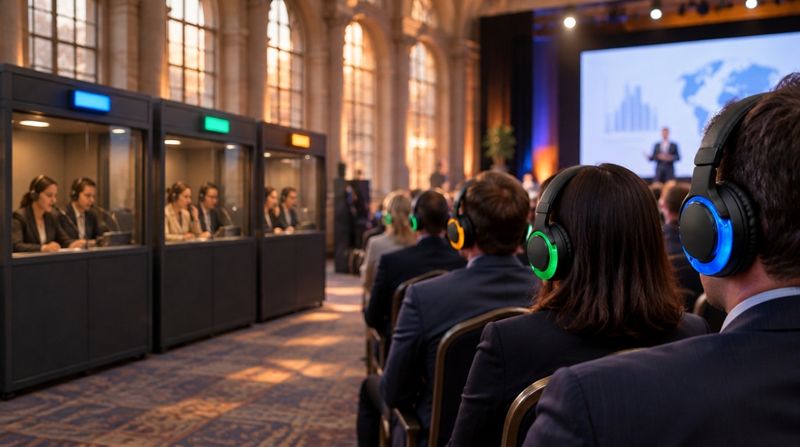
Interpreters working in booths at a conference while attendees wear LED headsets in different colours, one colour per language channel
Illustration — LED headsets, one colour per language channel

Multilingual events, one colour per language

For trilingual and multilingual events in Brazil, STIB offers an optional LED headset: each language channel is assigned its own colour, shown on the headset. The interpreters, booths and receivers are the same simultaneous-interpreting setup.

Trilingual events in Brazil

Process

How an assignment runs

Brief

Dates, hours per session, city or platform, languages in both directions, and what each session actually is.

Match & NDA

Interpreters assigned by language pair and sector experience; confidentiality agreement signed before material moves.

Prepare

Decks, contracts and glossaries studied in advance; equipment and audio specified per session.

Deliver

Interpreters on site or on the call, with technical support for the duration — including the parts of the agenda that change.

Straight answers

Interpreting, answered

What is the difference between simultaneous and consecutive interpreting?

In simultaneous interpreting the interpreter renders the message in real time while the speaker continues, which requires equipment and, beyond about an hour, two interpreters per language. In consecutive interpreting the speaker pauses and the interpreter delivers the passage, which needs no equipment but roughly doubles the clock time of the meeting.

Why do you quote two interpreters for a full day?

Because simultaneous interpreting means listening, analysing and speaking at the same time, and accuracy falls measurably after roughly 30 minutes of unrelieved work. Professional practice is a pair per language who alternate through the session. A short meeting under an hour can often be covered by one interpreter.

Where can STIB provide on-site interpreters?

In Brazil from the São Paulo headquarters and the Brasília office, with professional interpreters and simultaneous interpreting equipment on the ground in Recife, Rio de Janeiro and Campinas, and coverage also in Curitiba, Florianópolis, Santos and Salvador. In the United States, STIB has professional interpreters and simultaneous interpreting equipment on the ground in New York, Miami and Los Angeles. Anywhere else is covered remotely or by an interpreter travelling with the team.

Do you supply the interpreting equipment?

Yes. Booths, transmitters and receivers, or a portable system for smaller and mobile settings. Equipment is specified per session based on room size, number of languages and whether the session is streamed, and it is available locally in the US cities as well as in Brazil.

Which platforms do you use for remote interpreting?

Remote simultaneous interpreting runs on the platform your meeting already uses — Zoom, Microsoft Teams, Webex and others — with the audio chain tested before the session rather than on the day.

What should we send before the session?

The agenda, participant list, presentation decks, any contract or dossier under discussion, and internal terminology or product naming. Material sent in advance is the single largest factor in how fluent the session sounds, and everything received is covered by the confidentiality agreement.

How far in advance should we book?

Two to three weeks is comfortable for a multi-day or multilingual assignment, because interpreters and equipment are reserved together. Single meetings and remote sessions can often be arranged within days, and short notice is accepted subject to availability.
Related

Keep reading

Executive interpreting

One interpreter across a full travel itinerary, for C-level teams working across borders.

Executive

Board meetings & roadshows

Governance and investor settings, where interruption is the normal case.

Board meetings

Document translation

The paperwork that travels with the meeting, under the same glossary.

Translation

Tell us what is on the table.

The documents, the meeting, the dates and the languages. You get a scoped proposal from the team that will run the assignment.